

Why the first year of retirement is weirder than anyone tells you
And in The Times: 'Here’s how to work out how much you really need for retirement'
In this week’s edition:
Feature story: Why the first year of retirement is weirder than anyone tells you
From Bec’s Desk: Doing what you love
The Times: Here’s how to work out how much you really need for retirement
Know someone who’s starting to think seriously about retirement?
Why not forward them today’s newsletter? It might be the conversation starter they didn’t know they needed.

Why the first year of retirement is weirder than anyone tells you
I think we massively underestimate the first year of retirement, and the transition it really is. We put so much effort into getting to retirement day. We work out the numbers, when we can afford to stop working, what we’ll live on, and how to get rid of the mortgage. We plan the holidays, start making lists of the things we’ll finally have time to do.
Then you retire and for the first few weeks it can feel absolutely brilliant. There’s no alarm clock, no commute, and no dreading pull in your stomach on Sunday evenings. You take some trips, tackle a few projects you’ve been putting off around the house and throw in a few long lunches with old mates and it feels good.
Then at some point it dawns on you that wine and cheese at 4pm can’t become an almost-daily gig - and you’re not actually on a permanent holiday. This is your life now. And that’s where retirement can get a bit weird.
Most people recognise that work does a lot more than just pay you. It gives your week structure, and it gave you people to talk to. It even gives you a reason to get out of bed every day and be somewhere. And even if you’re truly ready to leave work behind, you might miss some of those things it gives you.
I hear this all the time from retirees - they don’t necessarily miss gong to work or doing work. They miss the banter, the people, the sense of shared purpose and the feelings of being useful. They also miss knowing what to do with their day.
It’s helpful to know before you get to retirement, that once the honeymoon is over, there really is an awful lot of time to fill up. And you’re not going to fill it with your bucket list. Chances are, you can probably only afford for your bucket list to fill it for a few weeks a year - maybe a few months. After that, it’s ordinary life that has to fill it.
So smile, knowing it probably will get weird and think about it in advance. Know there’s probably three important things to predict weirdness in, and prepare yourself for. Your everyday sense of purpose; your relationship; and your money.
Everyday life
If you’ve read my newsletters religiously, you’ll know I warn all the time about gap that can form in your day after the adjustment phase is over. It’s worthwhile thinking about this gap long before it appears and contemplating what you can do to fill it. Think about what gets you out of the house, who you’ll go to see, what keeps your body moving, and what you’re learning. Then contemplate what makes you feel useful. Answer all those and I suspect you’ll feel a lot less lost.Your relationship
You might have been married to your partner for 30 years, seeing them before and after work and on weekends for decades before now. But when you retire that shifts - and you’re usually home, together, all day long. Some couples revel in this and think it’s fantastic. Others need a period of re-negotiation and re-settling in to the new arrangements in the house. Remember - you don’t have to do everything together in retirement. In fact, I’d argue that having some things that are yours and some things that are theirs; and some things you do together is probably a great setup to think about.
Your money
You’ve been told to save, invest and build your pension for decades. Then your work income stops and you’re suddenly supposed to start spending down your nest egg, comfortably? And, if you’re in a couple, you’re both meant to know how to share that nest egg, all the risk, and all the fear of running out too. People really do find this hard.
And know, a £10,000 holiday feels different when there’s another salary coming in next month. When you take £10,000 from your pension pot and watch the balance drop - that can feel quite confronting - even when you’ve planned for it and you’re supposed to do it.
So maybe it’s worth thinking about the first year or two as a test - where you expect things to feel weird. Try stuff, and notice how it feels, whether you like the feelings, and contemplate your alternatives:
Join a walking group
Take a long slow holiday
Go back to work one day a week if you miss it and see I that fills your cup
Volunteer
Learn something new
Get properly fit and healthy
See more of your grandkids (but thank carefully before taking on a default babysitter role three days a week)
And pay attention to what you enjoy. You might just discover that some of the things you imagined doing in retirement aren’t nearly as much fun when you have unlimited time to do them. And other things you’d never considered become a bigger part of your life than you’d thought.
You don’t retire on friday and wake up on Monday knowing exactly how to do retirement. So don’t put pressure on yourself to know. That’s what the first year (or even years) is about - working out what you want to do with all that time.

I went to a rock concert this week. Most of you would remember INXS, the great Aussie band, and perhaps Noiseworks too. Well, Jon Stevens, the former lead singer of Noiseworks who later spent several years fronting INXS after we lost Michael Hutchence, came to my home town and played at a wonderfully grungy old pub.
And it was a terrific night out.
I love this stuff - live nostalgia I call it. Hearing songs you’ve known for 30 or 40 years, played loud, in a packed pub by someone who was actually there when they became part of the soundtrack of our lives. But what I loved just as much was watching Jon Stevens. He’s 64, his voice is still extraordinary, and he clearly loved being up there. You could see how much he enjoyed the music, the band and the crowd having a great time.
And I reckon there’s something in that. We talk so much about retirement as stopping work, but perhaps the real goal is getting to a point where you can spend more of your time doing the things you still genuinely love doing.
Jon Stevens just happens to get to do his very loudly - with a brilliant voice. 😎
We launched the new UK Epic Retirement Flagship Course last week and it’s now available to start whenever you like. It takes you through the money stuff, but also lifestyle, health, travel, purpose, housing and later life, because a good retirement is about a lot more than getting your pension sorted.
And we’ve added four live online Q&As with UK retirement experts each year, so even though the course is now on demand, you can still bring along your questions.
The 15% launch offer is still available for the first 50 people to enrol. Just use LAUNCH15 when you register.
Have a look at the course here.
Now, enjoy your Sunday. And perhaps go and do something this week that you still love doing very loudly.
Cheers Bec Xx

Author, podcast host, columnist, retirement educator, and guest speaker

The Epic Retirement UK Flagship Course
Planning retirement but not quite sure you’ve thought of everything?
The Epic Retirement UK Flagship Course helps you work through the money and the life stuff, so you can head into retirement with a clearer idea of what you want and how you’re going to make it happen.
What you get
Six weeks of guided learning with 14 practical modules covering your finances, lifestyle, health, housing, travel, purpose and later life.
Four live online Q&As each year with UK retirement experts, where members can bring along their own questions.
Three recorded Q&A sessions packed with real questions from people approaching retirement.
The Epic Retirement Conversation Starter Workbook to help you work through the big decisions with your partner or family.
Practical exercises and activities to turn what you’re learning into your own retirement plan.
A digital copy of How to Have an Epic Retirement – UK Edition.
Start whenever you’re ready. The course is available on demand, with new modules released progressively over six weeks.
15% off for our first 50 members
Use LAUNCH15 when you enrol.
Explore the course and get started →
“I have found this really helpful and it has helped inform the next stage of my retirement journey and made me think about things that I had not considered... I am very grateful for the course making me sit down and really think about how to manage my future, financially, emotionally and physically.”
– Angela, UK pilot participant
“I really enjoyed taking this course, even though I have read widely on the subject already and have a financial background. For anyone wanting to create some space to think about their current or future retirement, this is a great course to learn or in my case to challenge your own ideas and either reinforce your outlook or improve it.”
- Andy, UK pilot participant
“Any lingering doubts on your readiness for retirement? Then look no further... A well structured, easy-paced course that covers the retirement spectrum - from finances, to health, to travel, to purpose and then to later life - the course ticks every box. The 6 easy to complete weekly modules are supplemented by live Q&A sessions with industry experts to answer any questions you may have. A must do course for those thinking about, approaching retirement or who are already retired!”
- Michael, UK pilot participant

I am the retirement columnist for The Times, UK. You can read my most recent column here or look through all my columns here. My next column comes out this week. Here’s my most recent article:
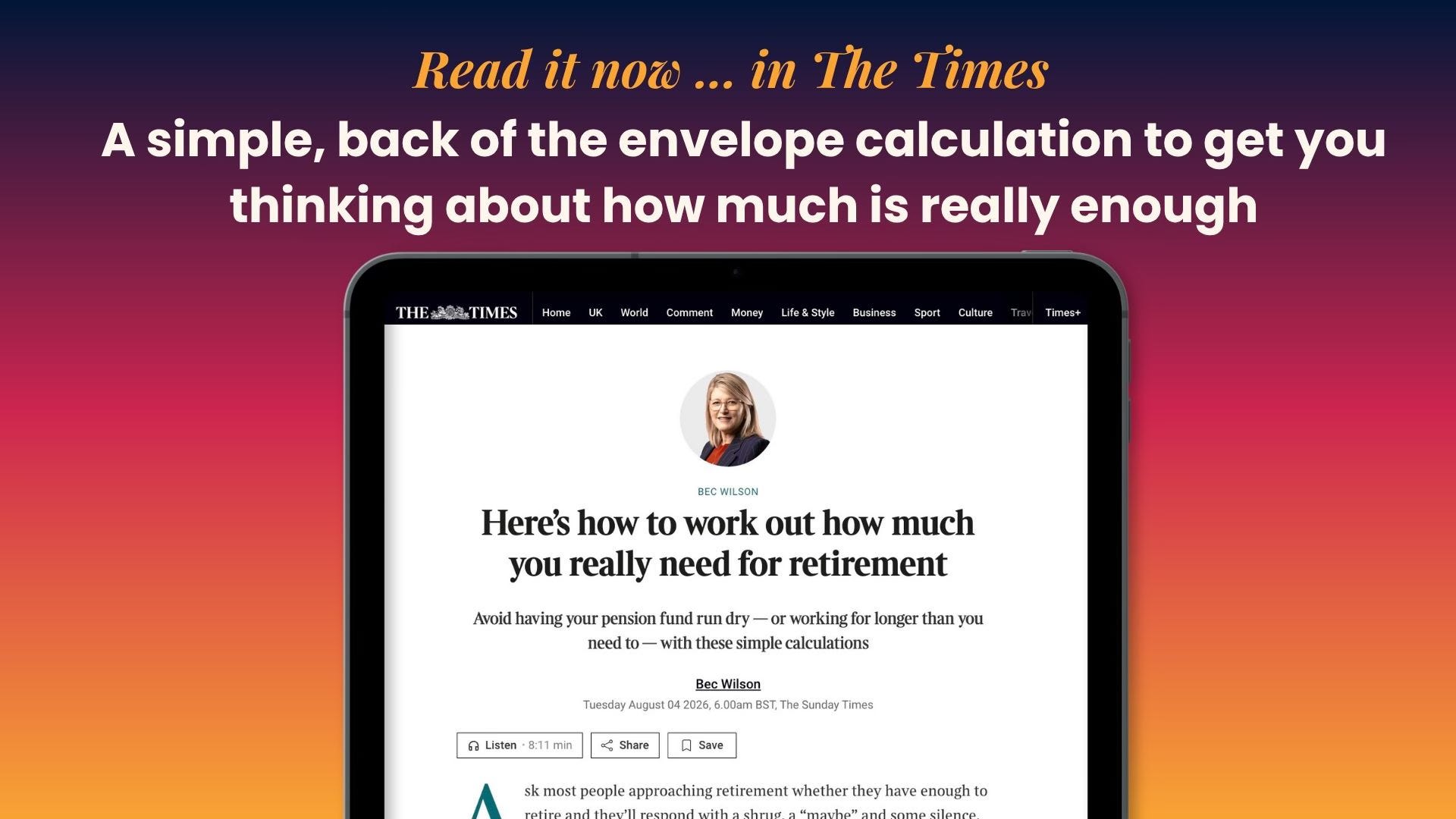
Here’s how to work out how much you really need for retirement
Avoid having your pension fund run dry — or working for longer than you need to — with these simple calculations
Ask most people approaching retirement whether they have enough to retire and they’ll respond with a shrug, a “maybe” and some silence. It’s one of the biggest gaps in retirement planning, and it’s stopping people from making more confident decisions about living their life well, winding back their workloads or simply knowing when it’s time to stop.
There are two big groups facing this problem: those who have more than enough, but are working long after they need to because they never sat down and did the sums; and those who retire and are too afraid to spend their hard-earned retirement savings, watching their pension pot like a hawk and living a smaller life than they need to.
If they’d just named their number, and become familiar with an annual process of checking their spending, they’d feel in control, even powerful about driving their own future.
There’s a really simple way to work out how much you need for retirement, and yet nobody explains it simply, because their job is to deliver complex advice. Mine isn’t. So let me teach you how I build a back-of-the-envelope retirement number.
Bear in mind, my goal here isn’t to plan your retirement in detail — it’s to give you enough confidence to explore it in more detail yourself. And let’s face it — 30 seconds with a pen and an envelope might just get you closer to thinking about your retirement than one of those boring calculators you’ve been meaning to use for the past ten years but will never do.
The article was published in The Times, on Tuesday 4th August and is available for reading here.
Got a topic you’d like me to cover? Send me a message
Simply hit reply and send me a note. I’m keen to know what’s worrying you, what is driving you and what you want more conversation and education about.
Why do I write a separate newsletter for the UK?
I write a separate newsletter specifically for the UK, because the financial system here is completely different to Australia, where I’m based. Your retirement is shaped by the State Pension, workplace pensions, ISAs and HMRC rules. Not superannuation or the Australian Age Pension.
If I just sent you the Australian version with a few words swapped out, it wouldn’t actually be useful to you. And useful is the whole point.
The big conversations, about when to step back from work, what you want the next chapter to look like, how to make your money last, those are universal. But the practical detail needs to reflect the system you’re actually living in. So that’s what we’ve built here. Tell your friends - we want to help you make your retirement epic - the UK way.
Is there a way to read the times articles without subscription