

Where should your next £300 go? Mortgage, pension or ISA?
An extra £300 a month could make a meaningful difference to your retirement. But the best place for it depends less on investment returns and more on the choices you want to create for your future.
In this week’s edition:
Feature story: Where should your next £300 go? Mortgage, pension or ISA?
From Bec’s Desk: A trip through central Australia
Know someone who’s starting to think seriously about retirement?
Why not forward them today’s newsletter? It might be the conversation starter they didn’t know they needed.

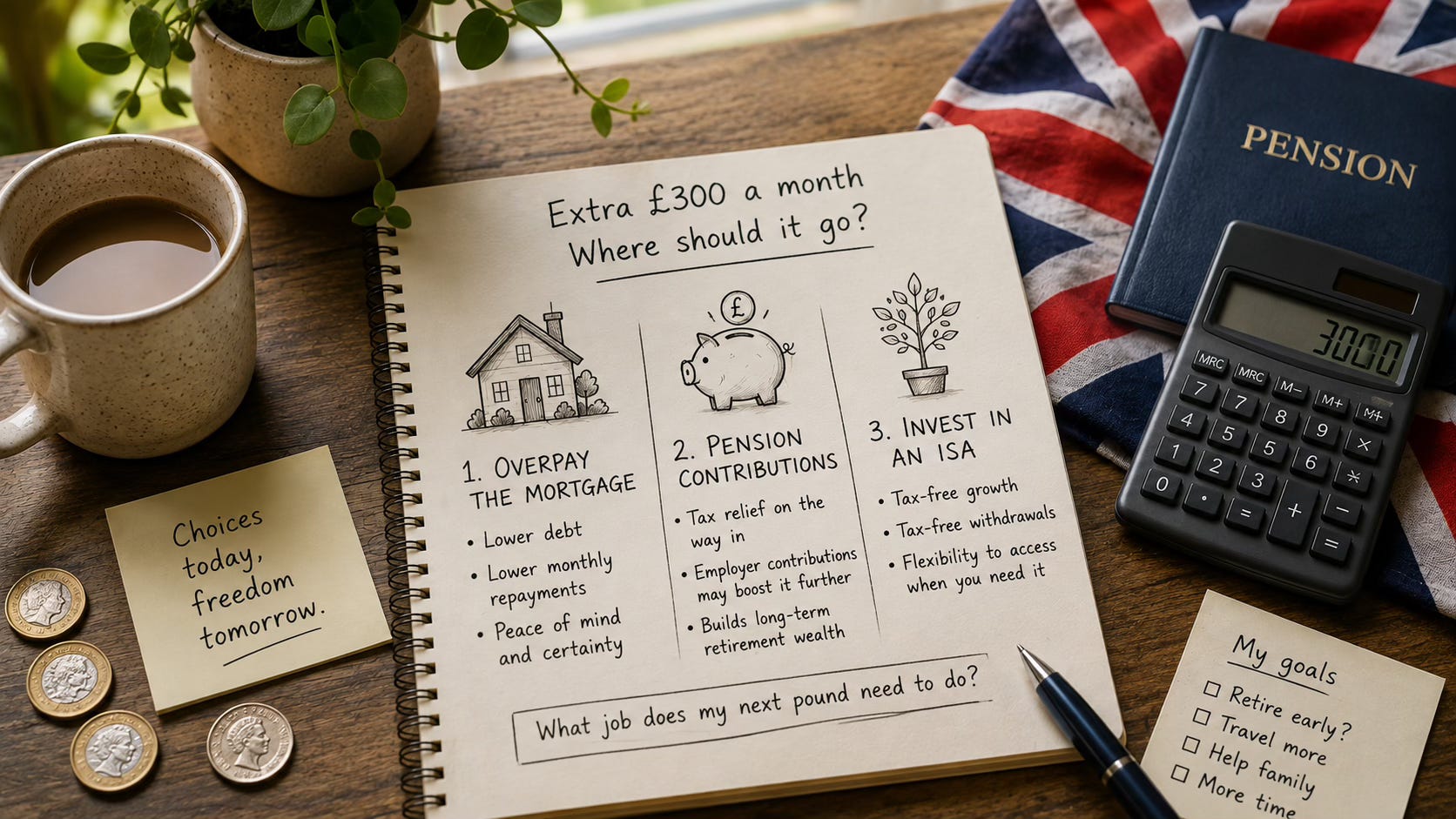
Where should your next £300 go? Mortgage, pension or ISA?
One of the nicest financial problems you can have as retirement starts to come into view is finding yourself with a little money left over at the end of the month.
For years, it probably felt like every pound already had somewhere to go. The mortgage, raising the children, saving for holidays, home improvements or even replacing the car. Life has a remarkable ability to absorb whatever we earn.
Then, often in our fifties, something changes (we all hope anyway).
The mortgage is often smaller than it once was. The children become more independent. Your earnings are often close to their peak. And retirement, which once seemed a lifetime away, suddenly starts to feel real.
That’s when people often ask a deceptively simple, but often difficult to answer question.
“I’ve got an extra £300 a month. Where should it go?”
Should I overpay the mortgage?
Should I contribute more to my workplace pension?
Or should I invest through an ISA?
At first glance, it sounds like a question about investments. But I don’t think it is. I think it’s really a question about choices. What they are really asking is:
‘How do I give myself the most options over the next ten years?’
Because that’s what retirement planning is really about. It’s not simply about building the biggest pension pot or paying off your mortgage as quickly as possible. Nor is it about chasing every tax advantage available.
It’s about creating choices, so that when life changes - as it inevitably does - you have options.
The interesting thing is that each of those three choices buys you something different. Making extra mortgage repayments buys certainty. Lower debt, less interest to pay and the comfort of knowing your home is becoming yours more quickly.
Contributing more to your pension buys tax efficiency. Thanks to upfront income tax relief - and, for many people, additional employer contributions - you can often invest considerably more than the reduction in your take-home pay would suggest. If retirement is only a few years away, that can make a meaningful difference to the size of your pension.
Investing through an ISA buys you flexibility. Unlike pension savings, your money remains accessible whenever you need it. That flexibility can be invaluable if you’re hoping to reduce your working hours, retire before you can access your pension, or simply want a financial buffer that isn’t locked away.
None of those outcomes is automatically better than the others. Their value depends entirely on what you’re trying to achieve.
Imagine three people, all with an extra £300 a month.
The first wants the security of owning their home outright before retiring. For them, overpaying the mortgage may be exactly the right decision.
The second wants to maximise the tax advantages available while they’re still working and let their savings compound and in the future, generate them income in retirement. They increase their pension contributions through salary sacrifice, benefiting from tax relief and potentially employer matching. They could even withdraw some of these funds later to pay down a mortgage.
The third hopes to leave full-time work several years before they can access their workplace pension and wants some options for how to tax-effectively draw down their money over the early years. They choose to build investments inside an ISA as well as a pension, accepting they may receive fewer upfront tax advantages in exchange for having some money they can access tax free later, when they need it.
None of these decisions is is right. None of them is wrong either.
They’re simply solving different problems. That’s why I’ve become increasingly uncomfortable with the idea that there’s a universal answer driven purely by investment returns.
I think the better question is:
‘What job does my next 300 pounds need to do?’
Before we look at the numbers, one important reminder.
I’m not here to tell you what you should do. Everyone’s circumstances are different, and that’s exactly why personalised financial advice exists.
My role is to help you understand how each strategy works, the trade-offs involved, and the kinds of situations where one approach may make more sense than another.
Let’s see what happens when the same £300 a month is directed towards each of those three options.
Strategy One: Reduce your mortgage
Suppose you have a mortgage charging around 5% and decide to overpay it by £300 a month. Over the next five years you’ll contribute £18,000 of your own money.
Assuming mortgage rates remain around today’s levels, those extra repayments would also save you thousands in interest and reduce the term of your loan.
And, unlike investing, the return is guaranteed. Every pound you repay earns a return equal to the interest rate you’re no longer paying. For many people that’s enough. For others, the peace of mind of reaching retirement with little or no mortgage is just as valuable as the financial return.
Strategy Two: Build your pension first, leverage any employer top up
Now let’s use exactly the same £300 differently. Instead of using that extra £300 to overpay your mortgage, suppose you decided to increase your pension contributions.
This is where the UK tax system starts really working in your favour.
Unlike an ISA or mortgage overpayment, pension contributions usually receive tax relief. If you’re contributing through salary sacrifice, you may also save National Insurance, and in some workplace schemes your employer may add to the contribution or share some of the National Insurance savings. The result is that considerably more than the reduction in your take-home pay can end up invested for your retirement.
Over five years, those larger contributions then have the opportunity to compound and potentially build a significantly larger retirement fund than investing the same after-tax amount elsewhere.
Of course, there are trade-offs. Your pension is invested, so its value will rise and fall with markets. And unlike an ISA, the money is generally locked away until you reach the normal minimum pension age. And even then, while you can usually take up to 25% tax free, future withdrawals are generally taxed as income.
That’s why this strategy tends to suit people who are comfortable leaving the money invested for their retirement and who want to make the most of the generous tax incentives available while they’re still working.
It also raises an interesting question that many people never ask.
‘Could I use my pension to help pay off my mortgage later, rather than paying off my mortgage before building my pension?’
For the right person, the answer may well be yes - that can be a good use of the tax free cash.
Strategy Three: Build flexibility with an ISA
Now imagine your goal isn’t simply retiring. It’s having the option to finish work a little earlier, reduce your hours, or create more flexibility over the next decade. Suddenly the equation changes.
A pension may be the most tax-efficient place to build long-term retirement wealth, but it isn’t the most accessible. That’s where an ISA comes in.
Investing the same £300 a month into a Stocks & Shares ISA allows your investments to grow free of UK income tax and capital gains tax, and any withdrawals you make are also tax-free. Unlike a pension, however, you don’t receive tax relief when you make the contribution.
In other words, a pension gives you tax relief on the way in. An ISA gives you tax-free growth and tax-free access on the way out. That’s an important distinction.
Your ISA might allow you to retire before you can access your pension, reduce your working hours, take time out to care for family, or simply give yourself confidence that your money is available if life doesn’t go to plan.
Sometimes having access to your money is more valuable than receiving the greatest possible tax relief. And notice, none of these approaches is universally better - they simply solve different problems.
The real question was never whether your next £300 should go to your mortgage, your pension or an ISA.
It was always this:
Which choice gives future you the most options?

I’m writing this on the flight home from Adelaide after four days travelling through the Australian outback on The Ghan Expedition - a sleeper expedition train journey from Darwin to Adelaide - with my daughter Paris.
We were guests of Journey Beyond, and I have to say, it was a remarkable experience. Four days on a train sounds like a long time, but between the spectacular scenery, outstanding restaurant quality food and wine, daily side-trips into the Aussie outback with experienced guides and the chance to explore parts of Australia that few people ever visit, it passed remarkably quickly.
It was the people.
Most were in their fifties, sixties and seventies, finally taking the trip they’d been talking about for years. And as someone who spends a lot of time thinking and writing about retirement, I couldn’t help noticing where so many conversations ended up.
They weren’t about pensions or investments. They were about life after work, and why they’d chosen to take the trip now and about the adventures they still wanted to have.
Almost everyone said some version of the same thing:
“I’m so glad we finally did it.”
I’ll share more about the journey in an upcoming episode of the Prime Time podcast, but it was a wonderful reminder that retirement isn’t just about having enough money. It’s about giving yourself permission to start living the life you’ve been planning for.
Our UK Course restarts this week!
We’ve spent the past few weeks refining the Epic Retirement UK Flagship course following our UK pilot, updating the content, incorporating participant feedback and making the experience even better.
I’m delighted to say it’s now almost ready.
From next week, you’ll be able to complete the course on demand, giving you the flexibility to work through the program at your own pace, wherever you are in the UK.
If you’d like to be among the first to know when enrolments open, join the waitlist below. Everyone on the waitlist will receive a special launch offer before the course goes live.
You can register yourself on our waitlist here.
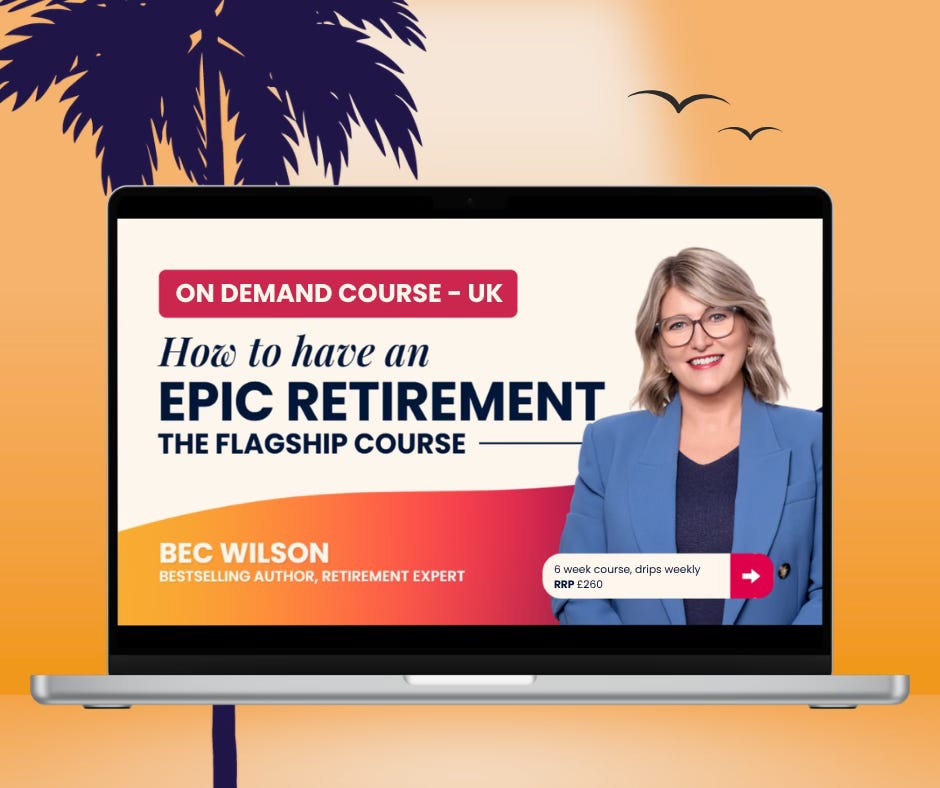
What’s included?
When you enrol, you’ll receive:
A six-week guided course featuring 14 practical modules that walk you through the financial and lifestyle decisions that shape an epic retirement.
Three pre-recorded Q&A sessions, where you’ll hear the questions other people asked as retirement approached - and the conversations that followed.
Four live online member Q&A events each year, giving you the opportunity to hear from retirement experts, ask your own questions and stay connected with the latest ideas. An exclusive events calendar is provided for members, and updated quarterly.
The Epic Retirement Conversation Starter Workbook, designed to help you have meaningful conversations with your partner, family or friends about the decisions ahead.
Interactive exercises and practical activities that help you turn ideas into action, one step at a time.
A digital copy of How to Have an Epic Retirement – UK Edition, included with your enrolment.
Whether retirement is just around the corner or still a few years away, you’ll leave with a clearer plan, greater confidence and practical strategies you can use to build a retirement that’s every bit as exciting as the years you’ve spent working towards it.
Now - enjoy your Sunday. Hope to see you on the course
Bec Xx

Author, podcast host, columnist, retirement educator, and guest speaker

I am the retirement columnist for The Times, UK. You can read my most recent column here or look through all my columns here. My next column comes out this week. Here’s my most recent article:
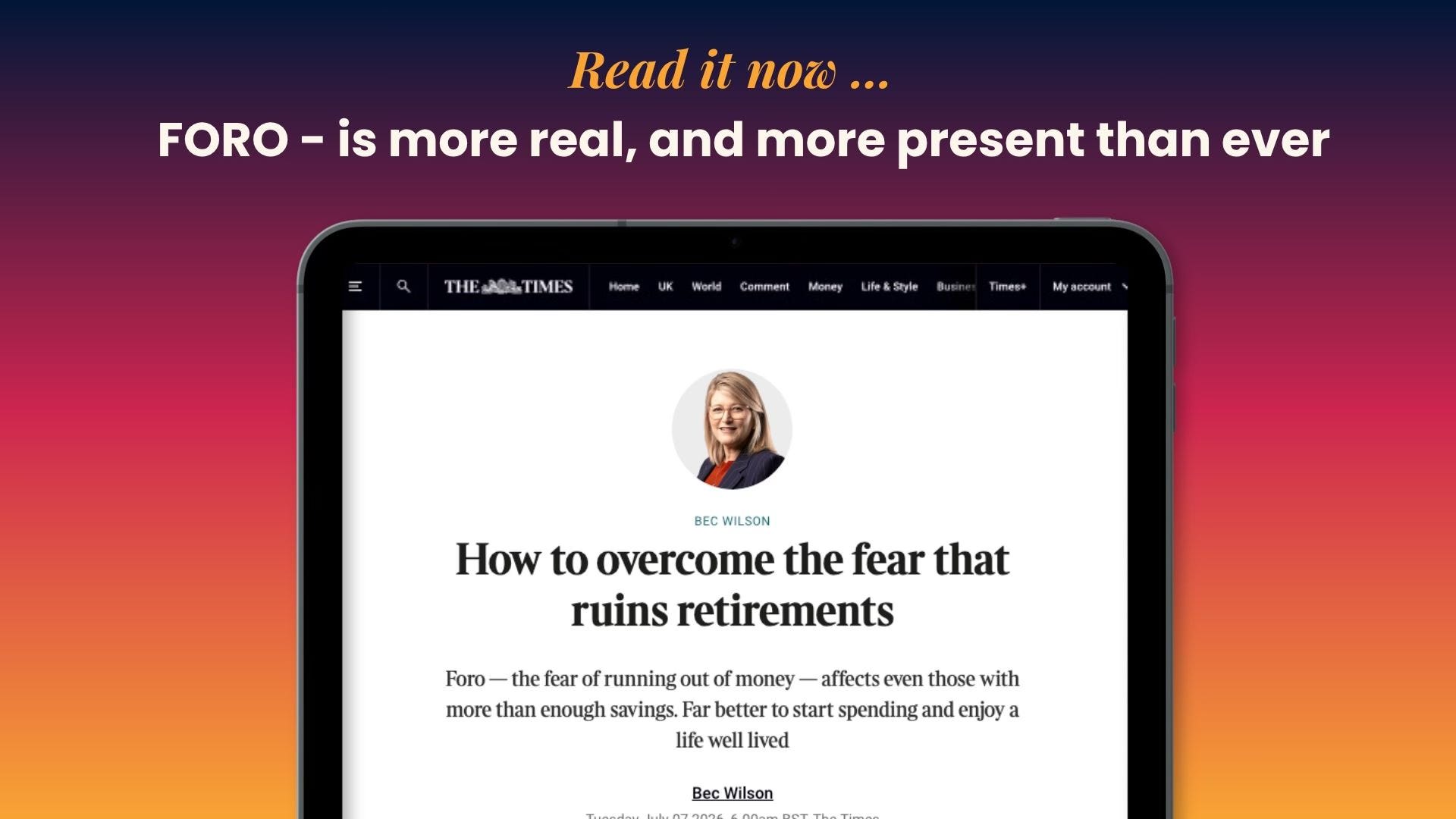
How to overcome the fear that ruins retirements
Foro — the fear of running out of money — affects even those with more than enough savings. Far better to start spending and enjoy a life well lived
Retirement comes with a big problem that we don’t talk about enough. There are people sitting on perfectly good pensions with quite healthy savings and no mortgages who cannot bring themselves to spend their money. They know that the numbers add up and they may even have a financial adviser who has told them they are going to be fine yet still they balk at the idea of spending.
This is called foro — the fear of running out. And it is more widespread, more stubborn and far more costly than most want to admit.
It can mean a life not lived to its fullest: trips not taken, bathrooms and kitchens not renovated, and years of the good stuff put off for the hypothetical “one day” that never seems to arrive. Meanwhile the money sits there doing nothing particularly useful and those who are meant to be enjoying their best years grow older.
The article was published in The Times, on Thursday July 7 and is available for reading here.
Got a topic you’d like me to cover? Send me a message
Simply hit reply and send me a note. I’m keen to know what’s worrying you, what is driving you and what you want more conversation and education about.
Why do I write a separate newsletter for the UK?
I write a separate newsletter specifically for the UK, because the financial system here is completely different to Australia, where I’m based. Your retirement is shaped by the State Pension, workplace pensions, ISAs and HMRC rules. Not superannuation or the Australian Age Pension.
If I just sent you the Australian version with a few words swapped out, it wouldn’t actually be useful to you. And useful is the whole point.
The big conversations, about when to step back from work, what you want the next chapter to look like, how to make your money last, those are universal. But the practical detail needs to reflect the system you’re actually living in. So that’s what we’ve built here. Tell your friends - we want to help you make your retirement epic - the UK way.