

The UK State Pension goes up this week: here's what changes
And, in The Times: "The Iran war shines a spotlight on Britain’s pensions divide"
What’s in the newsletter?
Feature: The UK State Pension goes up this week
From Bec’s Desk: Happy Easter!
Read my article in The Times: The Iran war shines a spotlight on Britain’s pensions divide

The UK State Pension goes up this week
Here’s what changes, who gets it, and what to check if you’re not there yet
The UK State Pension goes up again this week, and if you’re building your retirement plan around UK rules, it’s one of those numbers worth keeping an eye on.
From 6th April 2026, the full new State Pension increases from £230.25 a week to £241.30 a week. That’s an extra £11.05 a week, or about £574.60 a year.
For those on the older system, the full basic State Pension goes from £176.45 a week to £184.90 a week, an increase of £8.45 a week, or around £439.40 a year.
These new rates apply for the 2026/27 financial year and reflect the annual increase under the UK’s uprating rules.
That is all good news. But as always with the State Pension, the headline number is only part of the story.
Not everyone gets the full amount. Your State Pension depends on your National Insurance record. Under the current rules, people whose National Insurance record started after April 2016 generally need 35 qualifying years to receive the full new State Pension. If your record started before April 2016, it can be more complicated, especially if you were contracted out, and you may need more than 35 qualifying years to get the full amount.
So if you are already at State Pension age, the main thing to know is that the payment has gone up. If you are not there yet, the more important question is not really “what is the full rate?” It is “what am I personally on track to get?”
That is the bit a lot of people skip.
The earliest point you can receive State Pension is your State Pension age. For many people that is currently 66, but it is not the same for everyone. Under current legislation, State Pension age is rising from 66 to 67 between 2026 and 2028. If you were born between 6 April 1960 and 5 March 1961, your State Pension age will be 66 plus a number of months depending on your exact date of birth. If you were born from 6 March 1961 to 5 April 1977, your State Pension age is 67 under current law.
That means this is a very practical moment to check three things.
First, check when you will actually become eligible. The official GOV.UK State Pension age tool will tell you the age you can claim under current law.
Second, check how much you are on track to receive. The official State Pension forecast service shows how much you could get, when you can get it, and whether you can increase it.
Third, check whether you have any gaps in your National Insurance record. The forecast service also points out whether you may be able to improve your entitlement, including by paying to fill gaps in some cases.
This really matters because the State Pension is a foundation, but for most people it is not the whole retirement plan. Even with the increase, the full new State Pension works out to a bit over £12,500 a year at the new rate. Helpful, yes. Enough on its own for the kind of retirement many people want, not usually. That is why it makes sense to treat it as one layer of retirement income rather than the answer to everything. The useful work happens before you get there: checking your age, checking your forecast, checking for gaps, and then working out how it fits with your workplace pensions, personal pensions, savings and timing.
If you want a simple takeaway, it is this: the State Pension has gone up, which is good news, but if you are still a few years off, the real job this week is to make sure you know your own number, your own date, and whether there is anything you can still do to improve it.
I cover a lot more on this in How to Have an Epic Retirement, my UK Bestseller (An Australian/New Zealand edition is also available)

Hard to believe it’s April, isn’t it? And we’re bracing for what’s shaping up to be the most expensive fuel at Easter in history. Gulp.
I almost don’t want to admit I’m a Tesla owner at times like this. My car, a bottom-of-the-range Model 3, is no ego-wagon. It’s seven years old, white, and has cost me a grand total of $400 in servicing over its lifetime, and one set of tyres. So it’s quietly holding up its end of the bargain. How’s yours going?
Anyway, onto more serious things. This week was deliciously short. I keynoted two Adviser events in Australia. It also marked week 6, the final week of our Aussie Autumn How to Have an Epic Retirement Flagship Course.
I genuinely love running these courses and being part of the live sessions and I’m very excited to be launching the UK program in just weeks! I mean - check out this new feedback from the latest courses:
“I would consider this an essential course for everyone. I would recommend reading Prime Time and Epic Retirement, and unlike me at 62 years old and retired to do so earlier in life to be ready. Great coverage of lots of topics relevant to all of us. Thank you for the books and the course.”
“Feeling in a better place to handle everything now. Thank you”
“Terrific program. We loved the content and Bec’s delivery style is just so engaging. Highly recommend the course, and likewise Bec’s wonderful books “How to have and Epic Retirement” and “Prime Time”, and her podcast “Prime Time”.”
“This course has been very helpful. It has put the planning for retirement in to a structure I can follow and given me hope for an Epic Retirement. I was very anxious about my low super balance and nil savings, being divorced and having to do it all on my own. But now it feels doable. I can still do some of the travel overseas I have always dreamed of. Thanks for this opportunity to participate in this great course. Highly recommended to everyone over 50 years old.”
100% of people who’d finished this week said they’d recommend the course to their friends too!
I’m blushing. But honestly, what a buzz.
As I said, we’re putting the finishing touches on the workbook and course edits for the How to Have an Epic Retirement UK Course. We’re in the editing stage now, with all the filming done. It’s quite a big effort to product a course of this scale - one that runs for 6 weeks, with 14 modules (85+ videos) of lessons. And there’s a 130+ page workbook too!
As I mentioned last week, the course will take a very similar shape to the one we run in Australia, as it’s become quite popular here. We’ve locked down our live Q&A guests so we’re full steam towards releasing the course for sale in the next few weeks.
You can register your interest here (no obligation), and we’ll be launching at pilot pricing (very low for this first run so we can gather feedback and refine it with you). It won’t be long now…. We anticipate our UK Pilot course will start in May and go for 6 weeks finishing right as Summer holidays hit. So if you’re curious - sign up to learn more.
Now, that’s enough of the heavy stuff - it’s time for some chocolate.
Hope you’re having a lovely, family-or-friend-filled Easter. And there’s plenty of chocolate around you today.
Until next week — make it epic.
Cheers,
Bec Xx

Author, podcast host, columnist, retirement educator, and guest speaker


Get your copy of the new UK Bestselling pre-retirement guidebook, How to Have an Epic Retirement: Your ultimate guide to living well, loving life and retiring with financial confidence.

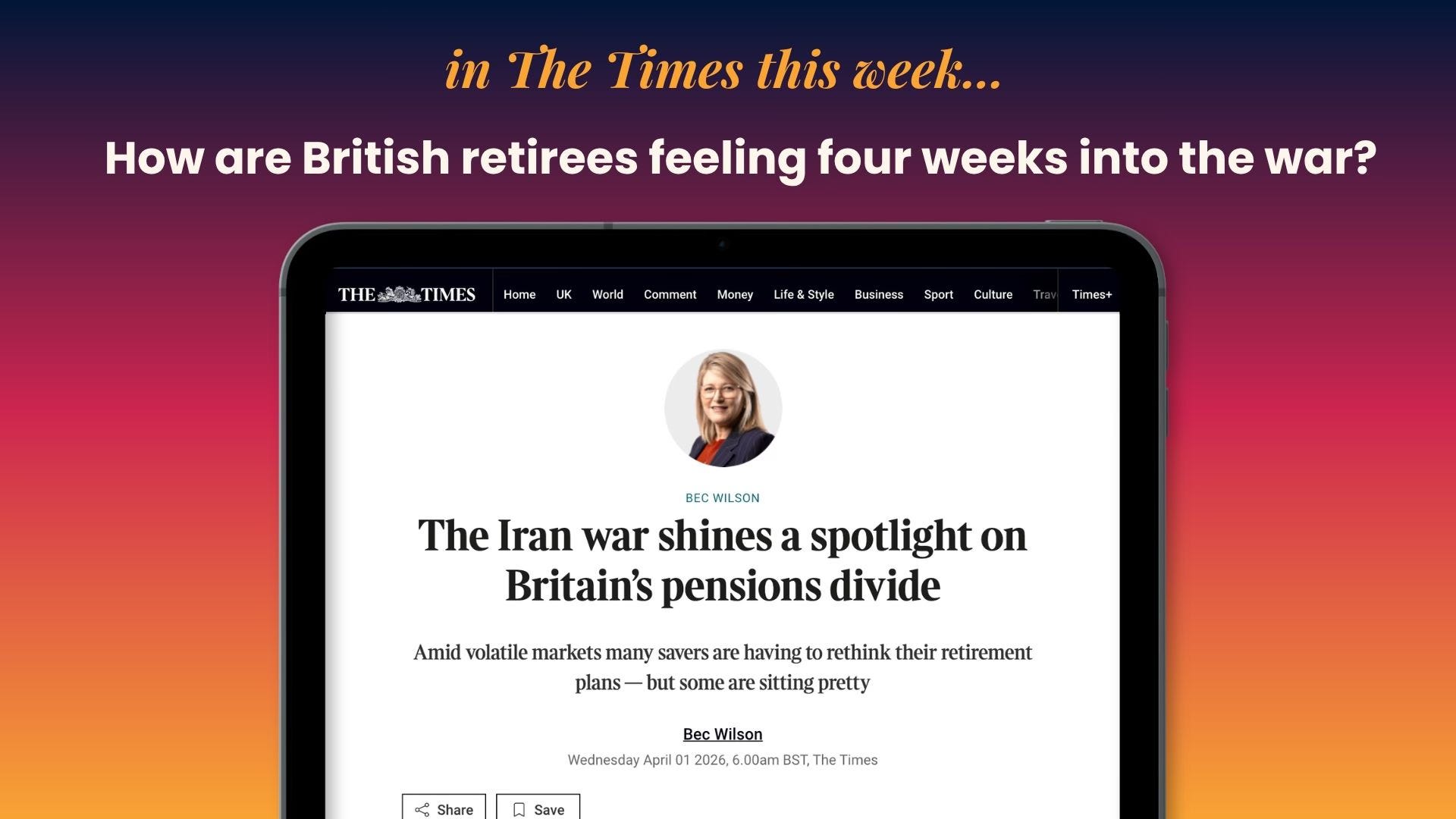
The Iran war shines a spotlight on Britain’s pensions divide
Amid volatile markets many savers are having to rethink their retirement plans — but some are sitting pretty
A month into the war in Iran and retired people are feeling the pressure, which is coming from many directions. I put the question out to my Epic Retirement Club on Facebook: how are you faring?
The responses came flooding in and they told a story of pragmatism tinged with genuine concern for what’s going on and how the war might develop from here.
The big pain points for those who are already in or on the brink of retirement are different from those affecting the rest of the population. That’s particularly the case for those who had a big date in mind: the sequencing risk problem is real but is not really appreciated by those for whom a specific retirement day isn’t looming.
If you’re still accumulating, a market downturn is painful but there is time to recover. If, however, you’ve stopped working and are drawing down to fund your living expenses, selling assets while prices are depressed damages your pot in a way that is not easy to undo.
Your income doesn’t rise with inflation if you do that and, without reversing your retirement decision, you cannot work extra hours to compensate for the money lost. If you had a retirement date circled on the calendar, the maths of whether you can actually afford to stop just got considerably more complicated.
Read the rest of this article here in The Times. It was published on Wednesday 1 April 2026. I write fortnightly for The Times - keep an eye out as my next article will drop soon!
I have signed up to express interest in the retirement course - if cheap enough would do it and happy to provide feedback in return . I’m not certain there is anything in particular I am going to get out of it as I am sorted financially and have a reasonable knowledge of money having been a tax adviser for 45 years and an amateur investment enthusiast. I manage my own stock portfolio. I have a retirement plan of sorts and am fully occupied with travelling, fitness, following football and writing. Have an active social life too.
But always curious to see if there’s a perspective I’m missing.
It’s not simple to find out how much you will receive because I believe the DWP computer was giving future quotes that did not take account of any opted out period. It is very difficult to get a quote due to Government Gateway system security. So how do know any quote is accurate?