

The thing most people don't realise they're buying when they pay for financial advice
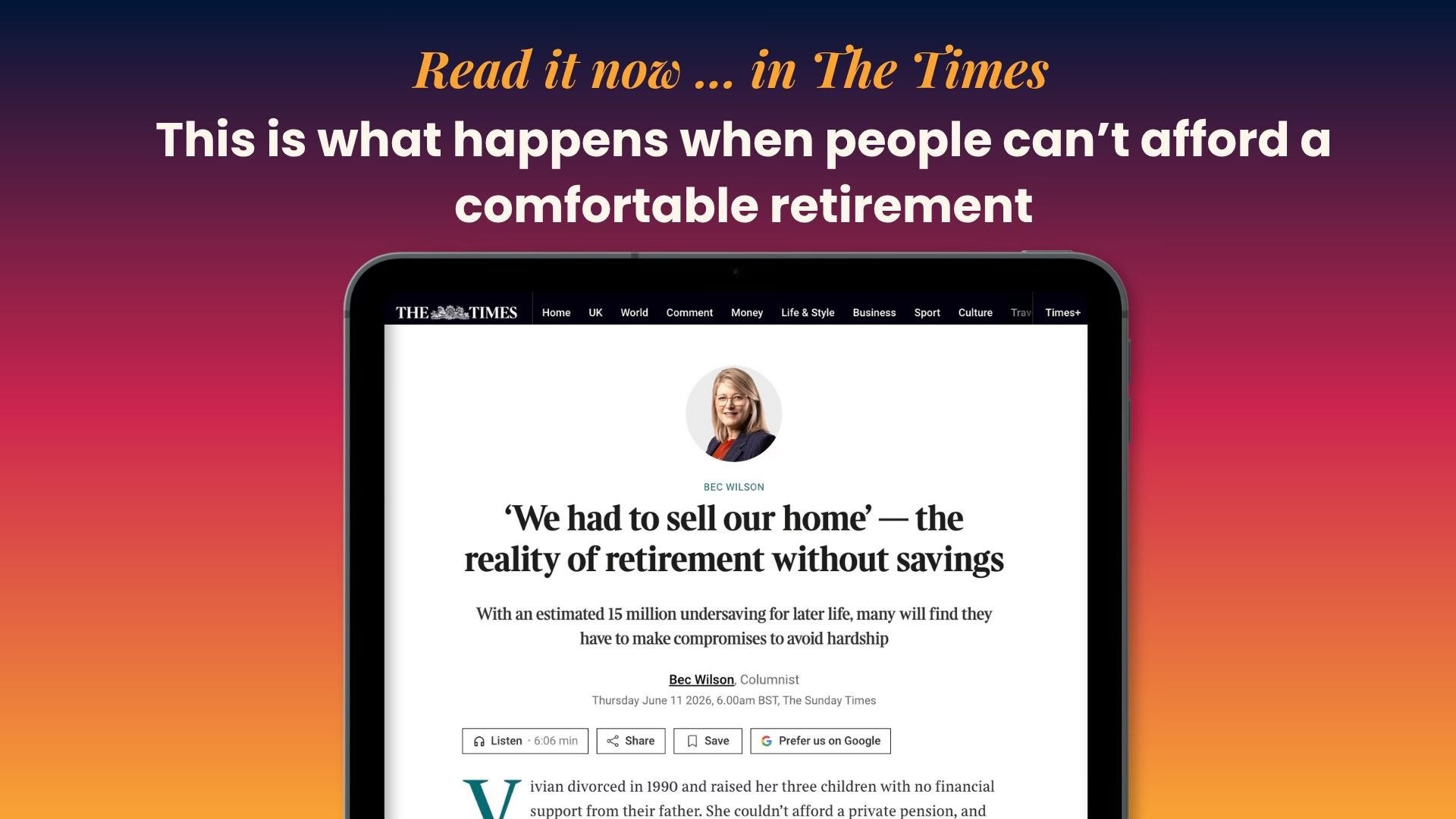
And, in The Times: '‘We had to sell our home’ — the reality of retirement without savings'
In this week’s edition:
Feature story: The thing most people don’t realise they’re buying when they pay for financial advice
The Times: ‘We had to sell our home’ — the reality of retirement without savings
From Bec’s Desk: the course continues


The thing most people don’t realise they’re buying when they pay for financial advice
I talk to people in the pensions and financial advice industry regularly. And there’s a widespread understanding amongst them about how people get advice and invest for retirement. What there isn’t, is much appetite to talk about how that’s changing because I’m not sure everyone wants you to understand it.
But it is changing. Largely without the people it affects most, everyday pension holders, knowing much about it. And I think it’s time we talked about it more openly, and without bias.
Here’s what most people think happens when they go to see an independent financial adviser.
They think they’ll pay for advice. Someone will look over their whole financial situation, track down their old workplace pensions, consider how everything is currently invested, work out whether those pensions are still fit for purpose, review their other investments and recommend the best path forward.
That’s certainly part of the process. Increasingly though, that’s not always where the conversation ends.
A pattern that’s becoming more common is for advisers to recommend consolidating old defined contribution pension pots into a SIPP on an investment platform, with the adviser then taking on the ongoing management of those investments. Your current workplace pension will often stay where it is while you’re still employed, but older pension pots are frequently part of that discussion. Once you retire, your current workplace pension may become part of it too.
For many people, that may be exactly the right solution. But it’s also a fundamentally different service from simply receiving retirement advice and choosing the best performing or best value for money pension to consolidate into.
To be fair, there are good reasons advisers recommend this approach. Platforms can make it easier to consolidate pensions, manage retirement income, rebalance investments over time, access a broader range of investments and review your strategy as your circumstances change. They can also make it easier for advisers to deliver those services efficiently. For people with more complex financial affairs, tax planning opportunities or who genuinely want ongoing advice and investment management, they can be an excellent solution.
A SIPP on an investment platform isn’t simply a recommendation about where your pension should sit. It’s a different structure entirely. You’re moving from your existing pension arrangement into an ongoing investment management relationship.
There’s another distinction many consumers don’t realise.
IFAs are required to understand your financial situation, objectives, attitude to risk and relevant personal circumstances before making recommendations.
They are not automatically required to carry out a whole-of-market comparison of pension providers unless that’s within the agreed scope of the advice. Their job is to recommend a suitable solution for your circumstances, but the scope of what they review is usually agreed at the beginning of the engagement.
That’s an important distinction.
One senior executive from a large pension provider told me recently that, in his view, the overwhelming majority of people who seek independent financial advice ultimately have their old pension pots consolidated onto an investment platform. I can’t independently verify that estimate, but after years of speaking with people across the pensions and advice industries, it’s certainly consistent with the direction the market appears to be heading.
That doesn’t mean the recommendation is wrong.
It does mean consumers should understand why this model has become so common.
When an adviser recommends consolidating your pensions onto a platform and then manages those investments on an ongoing basis, they create an ongoing revenue stream.
The Financial Conduct Authority says ongoing advice fees average around 0.8% of assets each year. By the time platform charges and underlying investment costs are added, total ongoing charges can approach around 1.9% annually.
Think of it like a subscription.
Many people don’t fully appreciate they’re signing up for an ongoing investment management service rather than simply paying for retirement advice. Around 80% of adviser charging revenue comes from ongoing services, making recurring advice the core commercial model for many firms.
That means the adviser who develops a one-off retirement strategy and leaves your pensions where they are will generally earn less than one who recommends a platform and manages your investments for many years.
None of that means a platform is the wrong recommendation. IFAs are regulated by the FCA, are required to make suitable recommendations and must comply with the Consumer Duty. But it does mean it’s worth understanding the commercial model before deciding whether it’s the right solution for you.
If you have multiple pension pots, significant assets, tax planning opportunities, more complex retirement income needs, or genuinely want someone managing your investments throughout retirement, they can be worth every penny.
But for many people approaching retirement who are already in well-run, competitively priced workplace pension schemes, another perfectly reasonable outcome may be to stay exactly where they are.
They might simply need retirement advice.
That could mean reviewing how their pensions are invested, setting up a retirement income strategy, deciding how and when to draw from different pension pots, understanding the State Pension, planning withdrawals tax-efficiently and reviewing their position every year or two.
If you’re over 50, Pension Wise also offers free, impartial, government-backed guidance to help you understand your retirement options before you pay for advice.
If your adviser recommends moving your pensions onto a platform, it’s worth understanding exactly what you’re swapping.
You’re potentially moving away from workplace pension schemes with significant governance, institutional buying power and large investment teams behind them into a structure where your investments are typically managed through portfolios recommended by your adviser and often constructed by external investment managers.
That may absolutely be the better solution for you.
Or it may not.
The important thing is understanding why the move is being recommended, what additional value you’ll receive, and whether that value is worth the additional cost.
My biggest concern is that people who simply want retirement advice, without necessarily moving their pensions onto a platform, may not realise that’s even an option.
If that’s what you want, say so.
Ask whether the adviser is happy to provide strategic retirement advice while leaving your existing pensions where they are or consolidating into your most attractive pot, if that’s the most appropriate recommendation.
Then ask these five questions.
What will happen to my pensions, and what will it cost in total compared with what I’m paying today?
What would your recommendation look like if I kept my existing pensions where they are or choose one to consolidate into and manage that myself?
Do I actually need ongoing investment management, or do I mainly need a retirement strategy?
How do you select, monitor and review my investments if I move onto a platform?
Why are you recommending I move onto a platform, and can you show me why that’s likely to leave me better off?
Good IFAs won’t hesitate to answer those questions.
And there are genuinely excellent advisers throughout the UK, just as there are excellent platforms.
But walking into the conversation understanding the difference between retirement advice and ongoing investment management changes everything.
The point isn't to avoid financial advice. It's to understand what you're buying, what you're paying for, and whether it's the right service for you.
Note: This article relates to defined contribution pensions only. If you have a defined benefit (final salary) pension, the rules around transferring are very different and regulated financial advice is generally required before any transfer can proceed. These pensions can be extremely valuable and are often best left untouched. Please seek specialist regulated advice before making any decisions.

The heatwave is all I’m hearing about from our UK community right now. I hope everyone is faring well and that the heat is dissipating.
This week in the UK Epic Retirement course we’ve enjoyed our second live Q&A with the energetic IFA and author, Dan Haylett. It was terrific. And it allowed people to unpack the lessons they’re learning diligently.
The six week course is going well. We’re now in week 5 and we’ve really been enjoying everyone’s feedback. A little taste:
“The course is fantastic: so clearly and well structured. Thank you”
“I have been enjoying this course immensely. I feel much more confident in my understanding of how this thing called retirement works!”
“I loved the phrase that doing wills and funeral planning is an “act of care” and will include that in conversations.”
Our Epic Retirement UK Flagship Course is going so well that we’ll be flipping it into an on-demand program you can access when it suits you to do the course as soon as the Summer program completes. You can register your interest for our full release here. We’ll offer a special deal for those who are pre-registered.
Enjoy the tail end of the heatwave. Hope it breaks soon.
Bec Xx

Author, podcast host, columnist, retirement educator, and guest speaker

I am the retirement columnist for The Times, UK. You can read my most recent column here or look through all my columns here.
‘We had to sell our home’ - the reality of retirement without savings
With an estimated 15 million undersaving for later life, many will find they have to make compromises to avoid hardship
Vivian divorced in 1990 and raised her three children with no financial support from their father. She couldn’t afford a private pension, and had almost nothing in workplace savings, despite decades of work, sometimes three jobs at a time just to make ends meet.
She should have retired last year but is working full time on minimum wage to cover her rent and keep her lights on. For her, a comfortable or even modest retirement is a long way from reality. The state pension will be her main source of income.
She is one of the members of my Facebook group, Epic Retirement Club, who shared their experiences this week. In a group full of proactive planners working hard to get ahead and use the systems of retirement to ensure that they will be comfortable, not many were willing to come forward in public and talk about what it feels like to not be on target. But plenty sent in private messages about their plight. It’s tough out there. And many of those who have retired, or who should have retired, are just scraping by.
The conversation came after the latest Retirement Living Standards from the industry body Pensions UK, which set out the estimated incomes needed for comfortable, moderate and minimum lifestyles in retirement - numbers that lay out what it really costs. Last month the government’s Pensions Commission reported that 15 million people in the UK were undersaving for retirement.
The article was published in The Times, on Thursday June 11 and is available for reading here.
Got your copy of How to Have an Epic Retirement - the UK edition yet? Order it now on Amazon here.

Got a topic you’d like me to cover? Send me a message
Simply hit reply and send me a note. I’m keen to know what’s worrying you, what is driving you and what you want more conversation and education about.
Why do I write a separate newsletter for the UK?
I write a separate newsletter specifically for the UK, because the financial system here is completely different to Australia, where I’m based. Your retirement is shaped by the State Pension, workplace pensions, ISAs and HMRC rules. Not superannuation or the Australian Age Pension.
If I just sent you the Australian version with a few words swapped out, it wouldn’t actually be useful to you. And useful is the whole point.
The big conversations, about when to step back from work, what you want the next chapter to look like, how to make your money last, those are universal. But the practical detail needs to reflect the system you’re actually living in. So that’s what we’ve built here. Tell your friends - we want to help you make your retirement epic - the UK way.
Welcome to the UK edition.Thanks for reading Epic Retirement UK! Subscribe for free to receive new posts and support my work.