

Scientists have proven that ageing doesn’t have to mean decline
And, in The Times: "The Iran war shines a spotlight on Britain’s pensions divide"
What’s in the newsletter?
Feature: Scientists have proven that ageing doesn’t have to mean decline
From Bec’s Desk: A quiet week
Read my article in The Times: The Iran war shines a spotlight on Britain’s pensions divide

Scientists have proven that ageing doesn’t have to mean decline
I’m going to ask you to set aside everything you think you know about getting older for a minute. Because a study has just been published in the the journal Geriatrics, from Yale, one of the world’s most respected research institutions, that has basically torn up the standard story about ageing. And I think it deserves way more attention than it’s getting.
Here’s the headline finding: nearly half of the older adults in the study actually improved in brain function, physical capacity, or both, over a period of up to 12 years.
Not “saw their health decline more slowly” and not “held steady as they got older!” They IMPROVED!
Just soak in that for a second!
The stories of getting old we tell ourselves become our reality
We have been marinated, from childhood, from every insurance ad, from every well-meaning doctor’s appointment, in a single story about ageing. That it goes one way - downhill, in a gradual and inevitable way, universally.
And, that story has been shaping your biology all throughout your life. But now, you could choose a different story to shape yourself around. One that has scientific backing!
The Yale researchers, led by Dr Becca Levy, followed more than 11,000 people aged 65 and over for up to 12 years. When they averaged everyone’s results together, which is how most ageing studies work, they saw what you’d expect – Decline. Cognitive scores dropped and walking speed slowed.
But then they did something different. They looked at individual trajectories instead of group averages. And that’s where things got interesting.
Nearly 45% showed improvement in cognitive function, physical function, or both. Around 32% actually improved their brain scores. Around 28% were walking faster at the end of the study than they were at the start.
So what made the difference?
Here’s the part that will either make you nod and smile or make you a little uncomfortable.
The researchers tested whether what people believed about ageing – the assumptions they brought into the study – predicted what actually happened to their health over the following decade.
And it did! Significantly.
People who held more positive beliefs about ageing were measurably more likely to show improvements in both brain function and walking speed, even after you account for age, sex, education, chronic disease and depression.
Your beliefs about ageing appear to be a biological input into how your body responds. Not just a mood or attitude. Something that’s actually shaping what happens inside your body over time.
Dr Levy has a name for this: ‘stereotype embodiment theory’. The idea is that from a young age, we absorb messages about what ageing looks like from ads, media, culture, the casual way people talk about getting old. Eventually those messages stop being abstract and become deeply personal. They shift from describing other people to describing you. And at that point, they start showing up in the body.
Her earlier research linked negative age beliefs to poorer memory, slower walking speed, higher cardiovascular risk, and brain markers associated with Alzheimer’s disease. This new study adds the other side of that coin: positive age beliefs predict improvement.
I find this extraordinarily exciting.
Something important to think about
I want to flag something specific in this research that I think it’s the most important part. The researchers didn’t just look at people who were struggling and got better. They did a separate analysis on people who had normal cognitive and physical function at the start – people who were already doing fine.
Among that group? Around 28% still improved their brain function over time. Around 23% improved their walking speed.
This wasn’t recovery from illness. This was people who were already healthy getting better as they got older
The researchers call it “reserve capacity.” The idea that later life holds more potential for growth than our culture has been giving it credit for. I’ve been saying this for years, and honestly it’s kind of wonderful to see Yale prove it.
So, what do you actually believe about getting older?
I ask this genuinely because I want you to stop and think about it.
If you’ve absorbed the standard cultural story (decline is inevitable, the body just fades, the brain slips, the best years of your life are behind you), that story may be doing you real harm. Not just to your mood or your motivation. Potentially to your actual health trajectory.
The good news and I want to be clear this is genuinely good news is that the researchers say age-related beliefs are modifiable. You can change them. And because you can change them, there’s real scope for doing something about it.
That might look like this:
Noticing the internal voice that says well, at my age... and asking whether it’s actually true
Deliberately seeking out people who are thriving – not just surviving – in their 60s, 70s, 80s
Pushing back when the cultural narrative around you defaults to telling you about your imminent decline
And let me be clear. None of this is about toxic positivity or pretending the challenges that come with getting older don’t exist. They do – ageing is real. But the research is telling us that the trajectory into later life is far less fixed than we’ve been led to believe – and that what we expect from life has a measurable effect on what we experience.
Maybe, if you already believe you’ll have an epic retirement, then you’re on the right path.
So here’s my challenge for you this week: Think about one story you’re telling yourself about ageing that might not actually be serving you? It might be time to rewrite it.
Source: Levy, B.R. & Slade, M.D. (2026). “Aging Redefined: Cognitive and Physical Improvement with Positive Age Beliefs.” Geriatrics, 11(2), 28.
I cover a lot more on this in How to Have an Epic Retirement, my UK Bestseller (An Australian/New Zealand edition is also available)

I realise every day, whether I’m walking downstairs to my little home office or driving to the airport for a speaking gig, that I’m a very lucky person to love what I do so much.
This week was a full week at the desk. Articles, podcasts, newsletters, courses. No events, no travel, no distractions. I got a lot done towards our UK Course, which is coming together beautifully. Next week makes up for it though: Adelaide and Tassie, here I come.
And if you haven’t caught my recent reels on social media, I’ve been doing a few short micro-lessons breaking down how to navigate retirement step by step. Worth a follow if you’re not already across them — link below.
We are indeed putting the finishing touches on the UK course (How to Have an Epic Retirement Flagship Course). It’s quite a big effort to product a course of this scale - one that runs for 6 weeks, with 14 modules (85+ videos) of lessons and a whole lot of integrated activities.
The course will be similar to the program we run in Australia that is becoming quite popular indeed. We’ve booked in our live Q+A guests. We’re just making sure all the tech is on track before we launch it for you to book your places. Not long now.
You can register your interest here (no obligation), and we’ll be launching at pilot pricing (very low for this first run so we can gather feedback and refine it with you). It won’t be long now…. We anticipate our UK Pilot course will start in late May and go for 6 weeks finishing right as Summer holidays hit. So if you’re curious - sign up to learn more.
Now get out there and love your Sunday.
And until next week — make it epic.
Cheers,
Bec Xx

Author, podcast host, columnist, retirement educator, and guest speaker


Get your copy of the new UK Bestselling pre-retirement guidebook, How to Have an Epic Retirement: Your ultimate guide to living well, loving life and retiring with financial confidence.

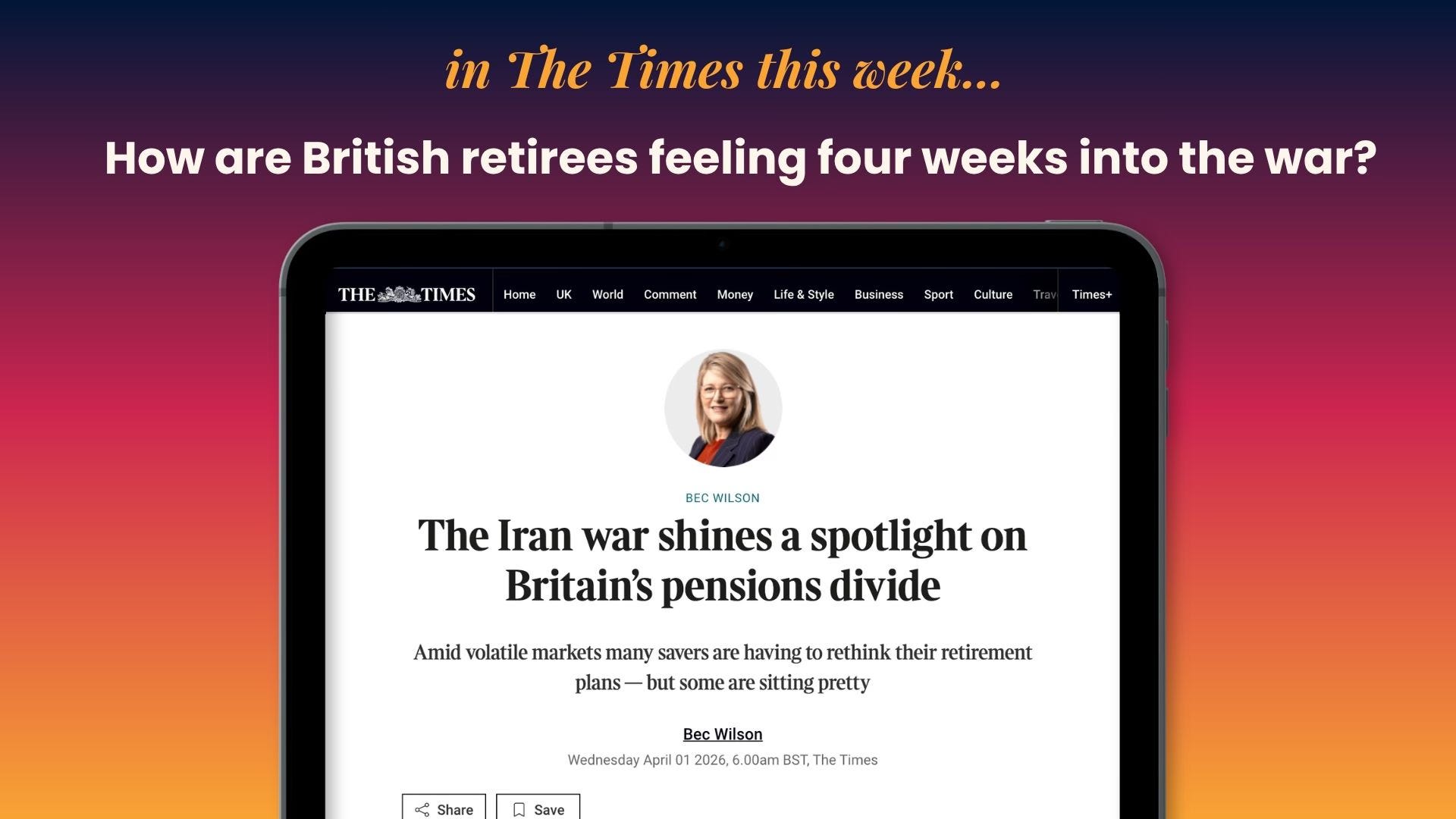
The Iran war shines a spotlight on Britain’s pensions divide
Amid volatile markets many savers are having to rethink their retirement plans — but some are sitting pretty
A month into the war in Iran and retired people are feeling the pressure, which is coming from many directions. I put the question out to my Epic Retirement Club on Facebook: how are you faring?
The responses came flooding in and they told a story of pragmatism tinged with genuine concern for what’s going on and how the war might develop from here.
The big pain points for those who are already in or on the brink of retirement are different from those affecting the rest of the population. That’s particularly the case for those who had a big date in mind: the sequencing risk problem is real but is not really appreciated by those for whom a specific retirement day isn’t looming.
If you’re still accumulating, a market downturn is painful but there is time to recover. If, however, you’ve stopped working and are drawing down to fund your living expenses, selling assets while prices are depressed damages your pot in a way that is not easy to undo.
Your income doesn’t rise with inflation if you do that and, without reversing your retirement decision, you cannot work extra hours to compensate for the money lost. If you had a retirement date circled on the calendar, the maths of whether you can actually afford to stop just got considerably more complicated.
Read the rest of this article here in The Times. It was published on Wednesday 1 April 2026. I write fortnightly for The Times - keep an eye out as my next article will drop soon!
I'm glad to hear that scientists have now proved it, but I really think a lot comes down to the individual. We were always told that as you got older, you got weaker, you got more sickly, and you got less will to live. What a load of bollocks!
I'm now 69 and 70 in a few months, and I retired quite early, about 62. I've been living here in the Philippines for the cold months of the year and back in the UK for the rest of it. It's not as expensive as you think.
The fact is, some people just go, "I'm old, I've got friends, I've got school friends, and I listen to them moaning and groaning rather than getting on with it." Yes, one day we're going to clock out; we don't know when it is, so my attitude is to do as much as you can before then.
This year I visited five islands. I've lost 30 kg in weight, and yes, I've even made income on the internet. The one thing I am certain of is that I can do most things I put my mind to. You can also. Don't let old age get you down. I have more confidence and more voice than I ever had. I think it's the best time of my life.
I love news like that after having to read many depressing people talk about ageing and citing dubious average stats on how long a person is supposed to live for healthily.
I’ve always thought it was a product of your own mind (within reason). So do the healthy stuff and don’t be average!
Start by saying sod those stats. I’m planning on living into my 90s healthily. And when I get there I will start planning how to get to my 100s.