

Are you one of the 15 million people?
And, in The Times this week: 'Your pension is primed to let you down at the worst possible time'
In this week’s edition:
Feature story: Are you one of the 15 million people?
The Times: Your pension is primed to let you down at the worst possible time
From Bec’s Desk: Our course is up and away


Are you one of the 15 million people?
Last week, the UK government’s newly reconvened Pensions Commission dropped a report that deserves more attention than it’s getting. The headline finding: 15 million people in the UK are currently undersaving for retirement. Without action, that figure could rise to 19 million.
That’s not a small problem. That’s roughly half the working-age population.
The Commission was clear about who’s most at risk: low and middle earners, the self-employed, and women. But here’s the thing - many of the people reading this newsletter would tell you they’re “doing okay” with their retirement savings. And some of you will be right. But some of you won’t.
So let’s do a quick, honest check.
Step 1: Do you know your State Pension forecast?
The full State Pension is currently £12,548 a year. It’s inflation-linked and guaranteed for life, which makes it genuinely valuable, but it won’t get you very far on its own.
To get the full amount, you need 35 qualifying years of National Insurance contributions. Fewer years means a reduced payment. If you haven’t already, check your forecast at gov.uk/check-state-pension. It takes about two minutes and it’s worth knowing exactly where you stand.
Also check for gaps in your NI record worth filling. Voluntary contributions currently cost around £17.75 a week per missing year, and each extra year could add around £330 a year to your State Pension for life. For many people, that’s a very good deal.
Step 2: Do you know what income you actually need?
Before you can work out if you’re on track, you need a target.
The Pensions and Lifetime Savings Association publishes the Retirement Living Standards - a practical guide to what different lifestyles actually cost in retirement. Here’s where things currently stand (these assume you own your home outright):
Comfortable — £43,900 a year for a single person, £60,600 for a couple
Moderate — £31,700 for a single person, £43,900 for a couple
Minimum — £13,400 for a single person, £21,600 for a couple
Subtract the State Pension and you can see the gap you need to fund from your own pensions and savings. For someone aiming at a comfortable single retirement, that gap is around £31,350 a year on top of the State Pension. For a couple aiming at comfortable, it’s around £35,500 on top of their combined State Pension of £25,096.
Those are significant numbers. And they’re exactly why the Commission is sounding the alarm.
Step 3: Are you actually on track - or just enrolled?
Here’s where a lot of people get caught out.
Auto-enrolment has been a genuine success - it’s brought millions of people into workplace pensions who would never have saved otherwise. But being enrolled is not the same as being on track.
The law requires a minimum total contribution of 8% of your qualifying earnings: 3% from your employer and 5% from you (including tax relief). That’s the floor, and for most people, it’s not enough to retire comfortably, especially if you started late or have gaps in your working history. Most people need closer to 10-12%.
If you’ve been contributing at the minimum for most of your career, do a quick sense check: log into your pension portal, look at your current pot size, and ask yourself honestly whether what you’ve built - combined with your State Pension - would fund the lifestyle you want for 20 or 30 years.
If the numbers feel uncomfortable, that’s useful information. It means there’s still time to do some work and adjust your vision and plans. And consider adjusting your pension contributions.
And be sure to read my article in The Times about pension investment returns in the run up to retirement. You might find your workplace pension is massively underperforming inflation and you could be effectively going backwards. Take a look!
Three things worth doing this week
Check your State Pension forecast at gov.uk/check-state-pension and look for any gaps in your NI record worth filling.
Log into your workplace pension and find your current pot value and contribution rate. Most providers let you do this online in a few minutes.
Pick a lifestyle benchmark from the PLSA standards above and work out how much you’d need in total savings to fund the income gap. A simple starting point: divide your required annual top-up by 4% to get a rough savings target.
None of this requires a financial adviser to get started. It just requires a bit of honest attention.
And if you want help working through all of this properly - understanding your pensions, building an income plan, and getting real clarity on where you stand - we’ve just launched our Epic Retirement course for UK readers. You can find out more and join us at epicretirement.net/program/pilot. It only started on Thursday so you still have time to catch up.
The Pensions Commission will publish its final recommendations in 2027. The system may well change by then. But none of that helps you if you’re sitting on the sidelines waiting to see what happens.
The only thing that matters right now is whether you are on track. Not the average person. Not the 15 million. You.
Go find out.

I’ve been head-down working on our UK Epic Course for months. And it’s finally here.
Our UK Epic Retirement Course kicked off beautifully on Thursday. Excited pre-retirees all jumped into the platform and started on Week 1’s lessons. It’s a six week program, and there’s three live events during the program too, after we get into the harder financial stuff and the ‘finding your purpose’. There’s still time to join the course. Just book your place and jump straight in.
I also got a hold of the pre-retirement performance data for workplace funds in the UK and was frankly quite horrified. So I wrote a long, detailed and constructive article for The Times. Make sure you’re looking if you’re in the run up to retirement. Some of the biggest funds are lower than inflation.
Aside from that, I’ve been in Sydney, making podcasts and attending our pensions-industry awards. And I’m looking forward to a quiet weekend. I hope you’re enjoying the run into Summer!
Now get out there and make your Sunday epic.
Bec Xx

Author, podcast host, columnist, retirement educator, and guest speaker
Why do I write a separate newsletter for the UK?
I write a separate newsletter specifically for the UK, because the financial system here is completely different to Australia, where I’m based. Your retirement is shaped by the State Pension, workplace pensions, ISAs and HMRC rules. Not superannuation or the Australian Age Pension.
If I just sent you the Australian version with a few words swapped out, it wouldn’t actually be useful to you. And useful is the whole point.
The big conversations, about when to step back from work, what you want the next chapter to look like, how to make your money last, those are universal. But the practical detail needs to reflect the system you’re actually living in. So that’s what we’ve built here. Tell your friends - we want to help you make your retirement epic - the UK way.
Welcome to the UK edition.

I am the retirement columnist for The Times, UK. You can read my most recent column here.
Your pension is primed to let you down at the worst possible time
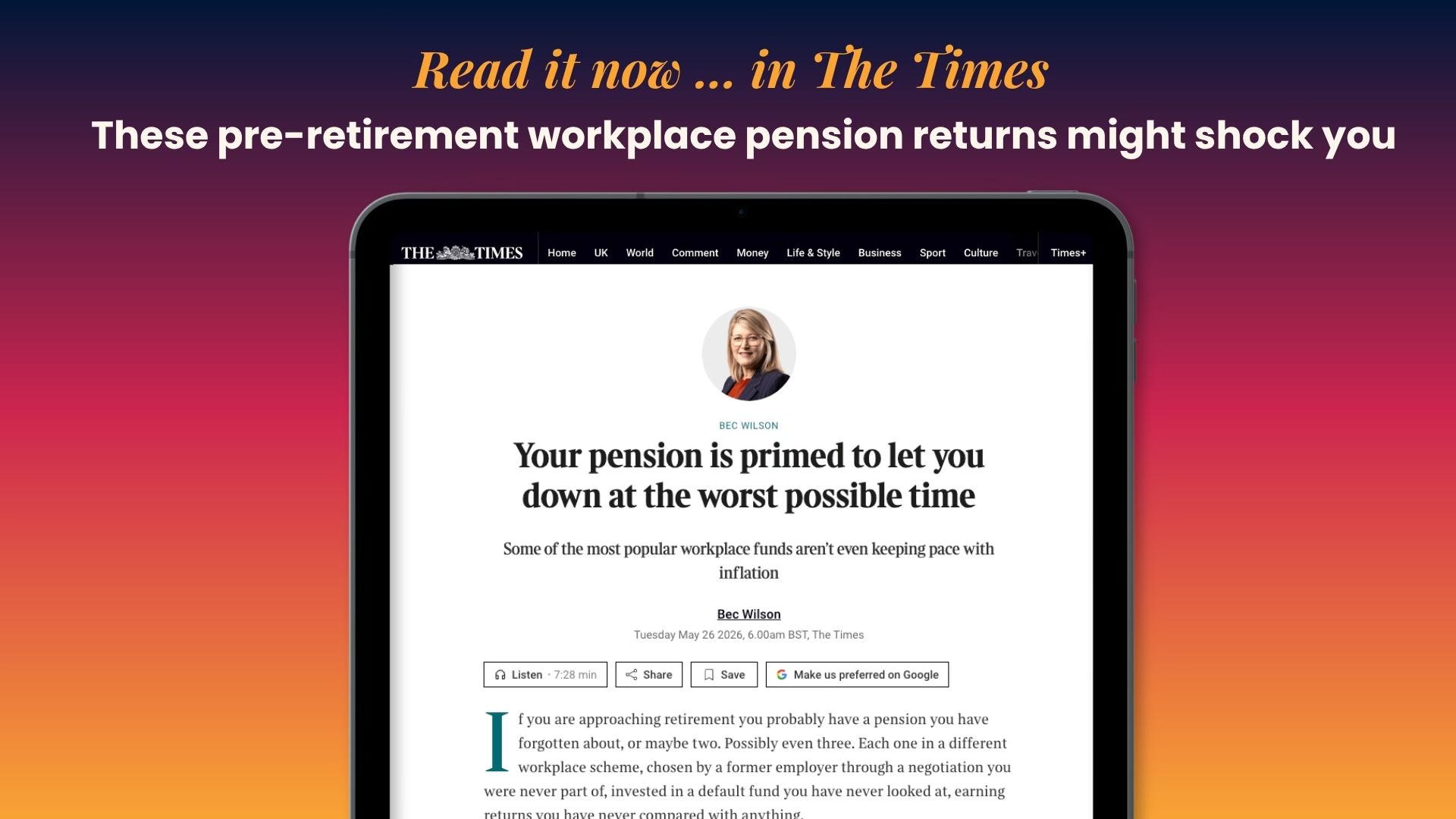
If you are approaching retirement you probably have a pension you have forgotten about, or maybe two. Possibly even three. Each one in a different workplace scheme, chosen by a former employer through a negotiation you were never part of, invested in a default fund you have never looked at, earning returns you have never compared with anything.
The system was clearly not designed to help you find out about, or monitor performance. If it had been there is no way the dreadful figures on pension performance in the five years to retirement would have been allowed to stand.
The analyst CAPAdata tracks the performance of UK workplace pension default funds and its figures show what has been happening to workers’ pension returns in the five critical years before they reach state pension age, known as pre-retirement. This is when the stakes are highest and there is little time to recover from a bad decision.
A pension pot at retirement still needs to last another 20 to 30 years, though, which means growth still matters enormously. I have spent years writing about retirement planning, and these numbers are worse than I expected for a period when global markets were delivering some of their strongest returns in decades. They should alarm anyone who has a pension in this country.
The best performing pre-retirement fund in the data set over the five years to March 2026 was the SEI Flexi Default, growing at a compound annual rate of 9.5 per cent — impressive. The worst was Scottish Widows, at a miserable 3.3 per cent a year, a rate that did not even keep pace with inflation.
The article was published in The Times, and is available for reading here.
"Step 2: Do you know what income you actually need?" - This section in your UK news letter is misleading. The values for living costs are after tax. And state pension is taxable. So you actually need to plan to achieve a much higher gross income than suggested here.